Free · No sign-up · Works in your browser
Grace Note
Write piano music or guitar tab, hear it played back, and print it out properly. It is free, there is nothing to install, and nothing you write leaves your own computer.
- Piano and guitar
- Plays what you write
- Prints on A4
- Works on a phone
Five to open and play with
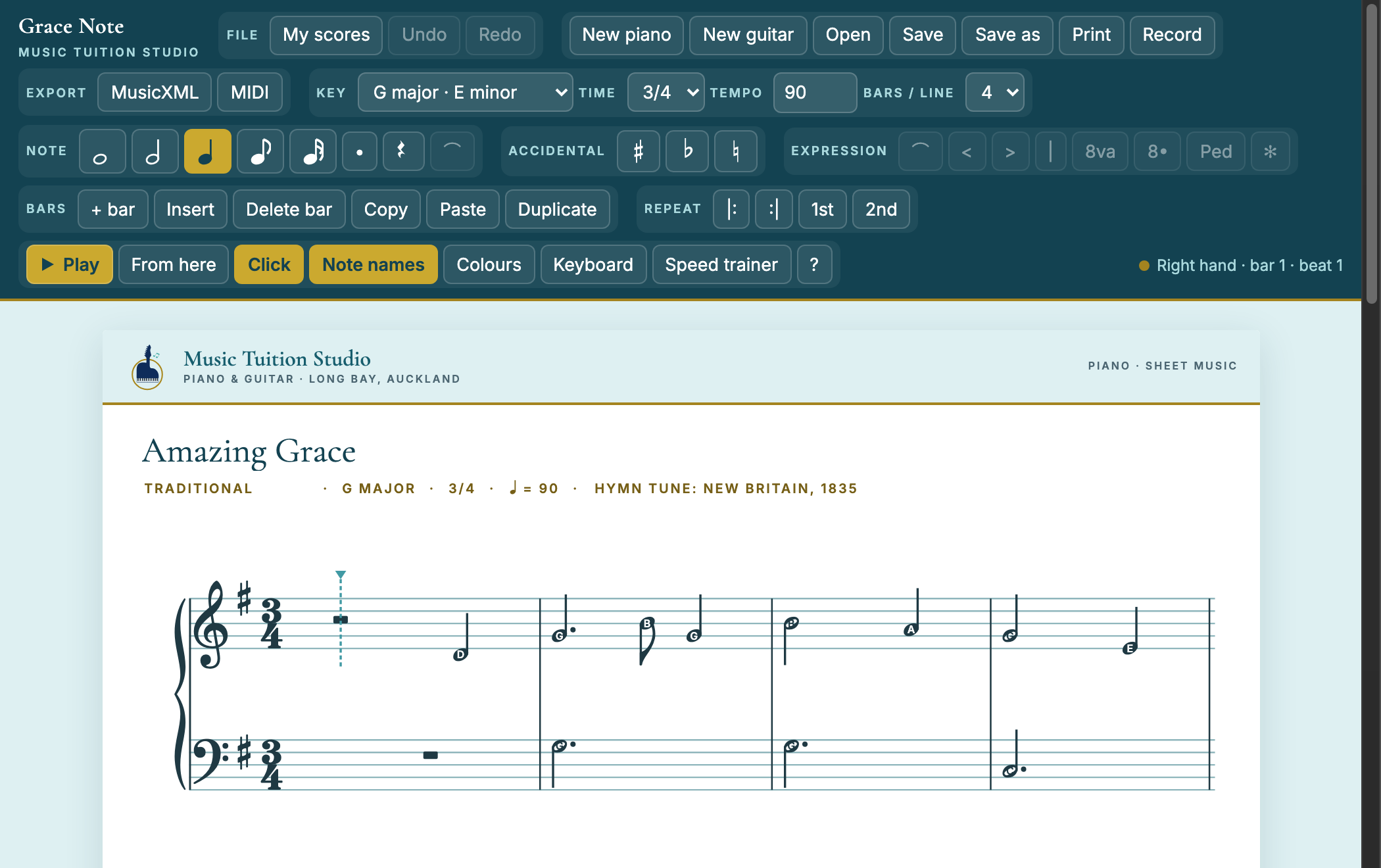
These open straight into the editor. Press Play to hear one, change any note you like, and print it if you want it on paper. Nothing is saved anywhere but your own browser, so you cannot break them.
- Amazing Grace The hymn tune, in G major. The whole melody uses just five notes, which is why it suits a first piece.
- Ode to Joy Beethoven's melody, and the classic first piece: it fits under five fingers without moving your hand.
- When the Saints Go Marching In The spiritual, in G major. Three notes lead into each long one, which makes the beat easy to feel.
- Greensleeves The English tune, written down before 1580. This one is guitar tab with the notation above it, all in first position, so you can see both ways of reading the same music.
- A singing warm-up A five-note warm-up with the words under the tune and a simple piano part below it. This is what a vocal line looks like: its own stave, its own voice, and words you can type straight through.
All five are out of copyright or written for this page, which is the only kind of music this tool ships. What you write is your own.
Eight free singing warm-ups
These are warm-ups from my own studio: a line to sing with the words written underneath, over a piano part simple enough that a beginner can play it and sing at the same time. Click one and it opens in Grace Note. Press Play to hear it, and Print for an A4 page to stand on the piano.
All eight are in C major with no black notes, and nothing goes below middle C or above the C above it, so they suit a young beginner's hand and a young beginner's voice. If they sit too low or too high, Transpose moves the whole thing, words and all.
Start here
- 1. Here's a Little Song Three notes up and back, and the same shape moved up a step each time. The first thing to sing once you can match one note.
- 2. Sing It High and Low The notes of a chord instead of the notes next door, so the ear has to leap. “high” sits on the highest note and “low” on the lowest.
- 3. Slowly Now In three, slower, with a note held for a whole bar at the end of every line and a breath marked over the next. The exercise is the breath.
- 4. Fingers One to Five The right hand plays exactly what the voice sings, one finger to a note, with the fingering written in. Doing both at once is the whole point.
When those are easy
- 5. Hopping Up the Stairs Up a third and down a step, the shape climbing as it goes, so the ear keeps having to find a note it did not just sing.
- 6. Sing High, Sing Low Two notes on one word. For a singer that is a held vowel; for the hand it is the down‑up gesture that comes next in every method book.
- 7. Sing a Happy Song Four bars that fit against themselves two bars later — a round for two, printed the way a songbook prints one, with a boxed 2 where the second singer comes in.
- 8. Walking and Running The first note shorter than a crotchet, two to a beat against the walking notes. The words say which is which.
Words and tunes written for this studio, which is the only kind of music this tool ships. Print them and use them at home as much as you like.
If you have never written music before
You do not need to know what the notes are called. Tap a key on the on-screen piano, or a fret on the guitar neck, and it goes on the page. Turn on note names and every note has its letter printed inside it, the way a first tutor book does.
There is a Kid setting that does all of that at once: letters in the noteheads, a colour for each note, bigger buttons, and only the four note lengths a beginner needs. Intermediate and Advanced add the rest back as you want them. Nothing is ever taken away — the setting is one menu at the top left.
There are things to start from rather than an empty page: the five pieces above, blank manuscript paper, blank tab paper, a C major scale with the fingering written in, and a twelve-bar blues.
If you already read music
Chords, ties, dotted notes, key signatures, repeats and endings, slurs and hairpins, dynamics, ornaments, grace notes, 8va and the pedal. Guitar tab has hammer-ons, pull-offs, slides, bends, vibrato, palm mutes and harmonics, and you can drag a note between strings and keep its pitch.
There is a sung line for songs: a stave of its own above the instrument, with the words typed straight through — a syllable, then space or a hyphen, and it moves to the next note by itself. Second and third verses sit under the first.
Transpose moves a whole piece into another key, words and chord symbols with it, and on a guitar the tab is re-fingered. Each stave can play back as a different sound — piano, guitar, electric piano, organ, strings, marimba, bass or voice.
When you want it somewhere else, it exports as MusicXML — which opens in Sibelius, MuseScore, Finale, Dorico and Guitar Pro — or as a MIDI file. And everything you have written can be downloaded as one backup file from My scores, which is worth doing: your work lives in this browser and nowhere else.
Common questions
Is it really free?
Yes. There is no account, no trial and no upgrade. I teach piano and guitar for a living; this is a thing I built for my own students and there is no reason not to leave it open.
Where does my music go?
It stays in your own browser. Nothing is uploaded and I cannot see it. Use Save to keep a copy as a file — that is the only copy that survives clearing your browsing data, so save anything you care about.
Can I print it?
Yes, on ordinary A4. The blank manuscript and blank tab templates are worth printing on their own if you just want paper to write on.
Will it work on a phone?
Yes. A tablet is more comfortable, and a laptop more comfortable again, but it works on a phone and you can write with your finger.
Who made it?
I am Adam Whybro. I teach piano, guitar and beginner singing at my studio in Long Bay on Auckland's North Shore, and I built this for the students I teach.
Lessons in Long Bay
If you would like to be taught rather than work it out alone, I teach at 24 Westerley Place, Long Bay, weekday afternoons and early evenings. $35 for a half hour.